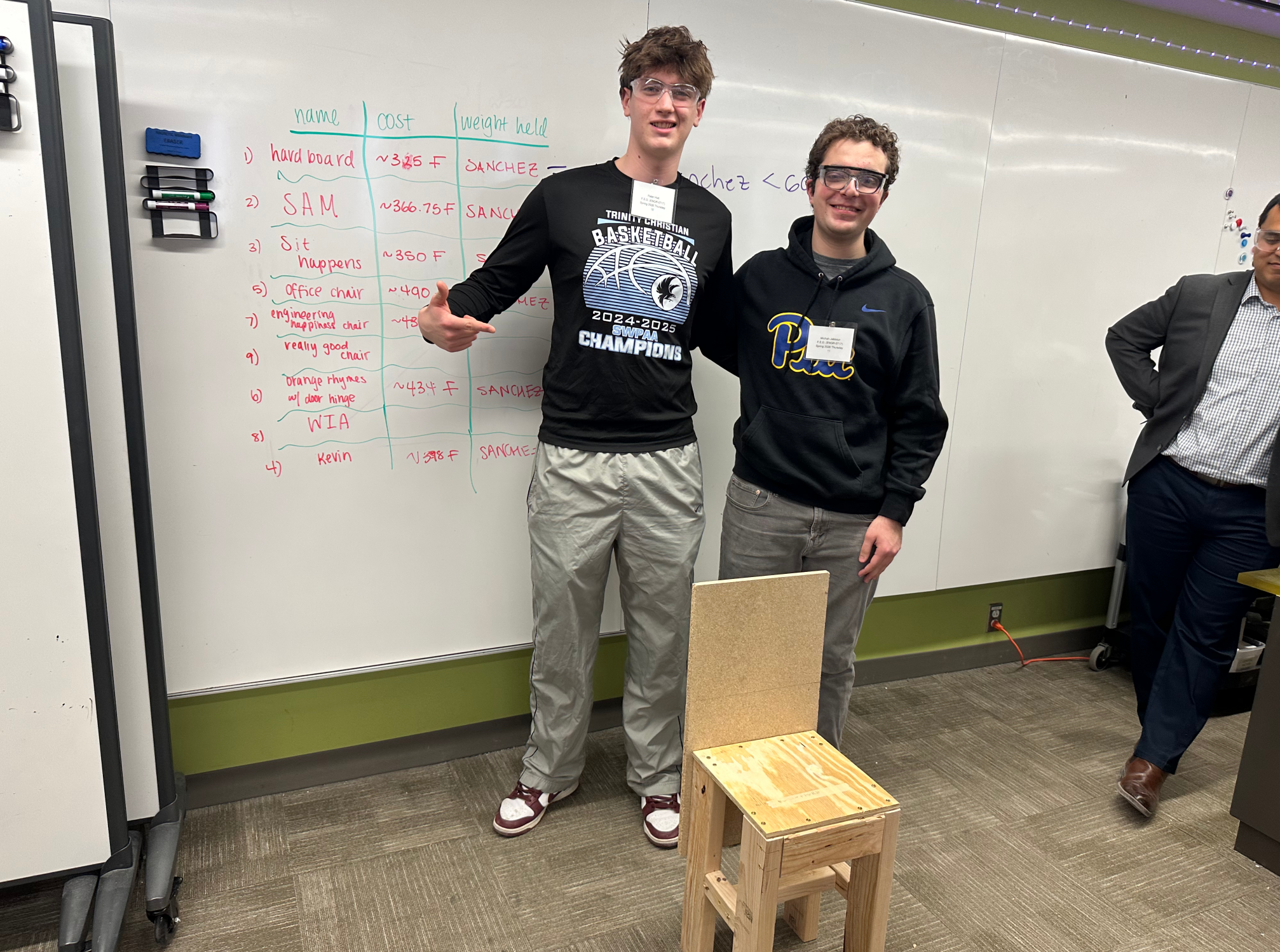
Timber Chair
This was part of a design challenge for ENGR717, Foundations of Engineering Design.
My teammate and I learned how to construct using wood and other timber composites. We designed and built a chair which during testing was able to hold 600 lbs. We did not test it to destruction, so we don’t actually know its true limits.
Below is part of our lab report about the chair.
Budget/Materials
We were given fake currency to add a cost limit to our design. We were not to exceed 500₣.
| Material | Price | Quantity | Cost |
|---|---|---|---|
| Pine Lumber (2x4 in) | 75₣ / 24 in. | 99.5 in | ~311₣ |
| Particle Board (0.626 in) | 55₣ / 2 ft2 | 2 ft2 | 55₣ |
| Plywood (0.5 in) | 80₣ / 2 ft2 | 1 ft2 | 40₣ |
| Screws | 1₣ / unit | 34 | 34₣ |
| TOTAL: | 440₣ |
Cost-to-Weight Ratio:
440₣/600(+)lbs = .7333 ₣/lb. For each ₣, we were able to support 1.363(+) lbs, meaning that the ratio is better than one ₣ per lb.
Factor of Safety:
600(+)lb/200lb = 3. Our chairs factor of safety is greater than 3, since it supports more than 3 times as much as the design load.
Performance Assessment:
The aspects that worked best were the use of the 2x4s for the bottom half, as it was the strongest available material. The cross beams also helped a lot to minimize stress, even when being rocked with 600 pounds of weight on top.
Everything in our design worked as we intended it too. The highest weight available to test with was not enough to break or even weaken our chair.
The chair performs about as expected, as it did not fail, even under the maximum load available. It is still structurally sound. This is because we designed our chair to be able to withstand high weights.
Real-World Applications:
In the real world, strength and cost are not the only 2 factors. You also have to worry about durability, as you would want something that you build to last a while, especially in construction. In addition, you would have to factor in comfortability if you were to design a chair for real customers.